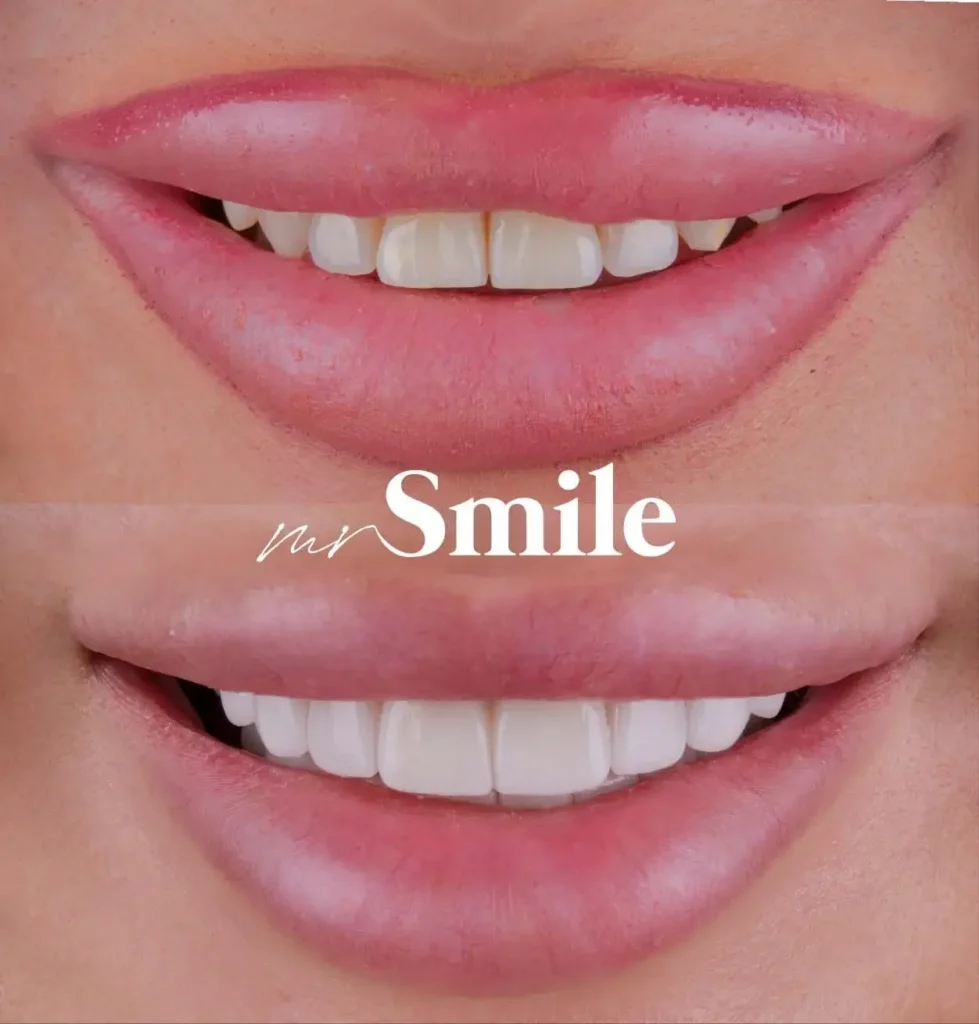
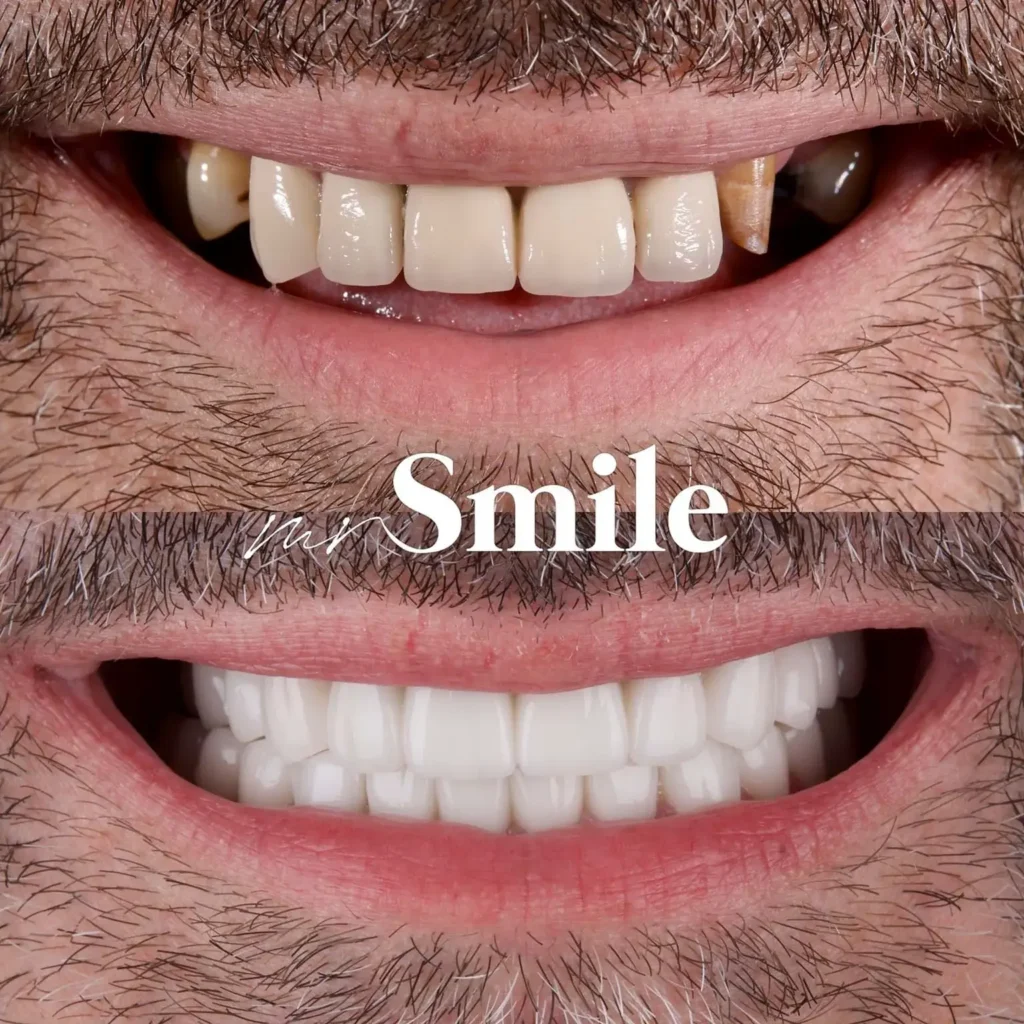
Photographs No Prep veneers before and after Before-and-after images are often a patient's first encounter with the possibilities of modern aesthetic dentistry. A few seconds are enough to notice a closed gap, a more harmonious shape of the front teeth, or a smile that appears brighter and more balanced. However, the quality of an aesthetic treatment is not assessed solely by how striking the 'after' photograph is. It is important to understand what was changed, by which procedure, why that procedure was chosen and whether it would be suitable for your teeth.
In the Mr Smile approach, the photograph is the start of the conversation, not a promise of an identical result. The method No Prep veneers by Nemanja Mihaljčić, individualised smile planning, Mr Smile Preview and collaboration with the laboratory help to connect the aesthetic desire with the actual condition of the teeth, gums and bite. Below we explain how to view the transformation gallery in an informed way — as a useful guide to the questions you will raise at consultations.
No-prep veneers before and after: what can photographs really show?
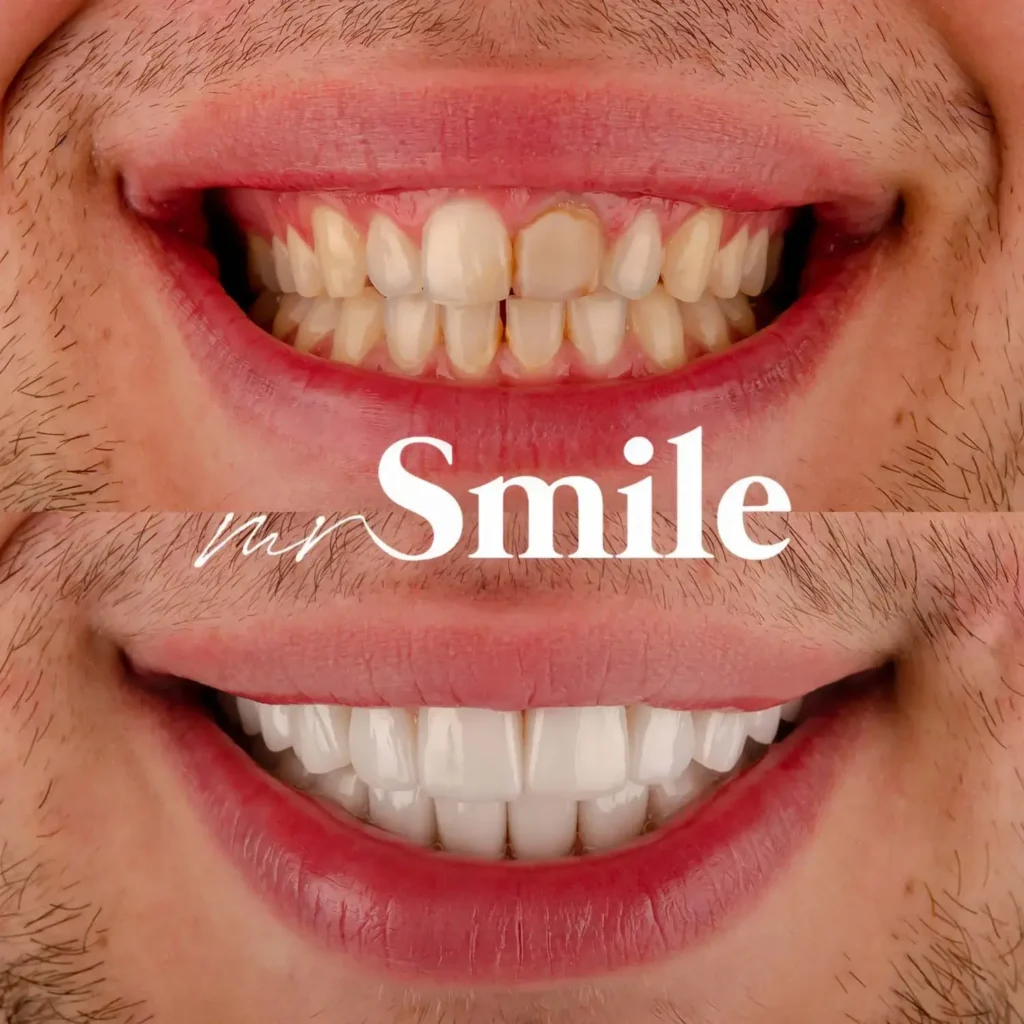
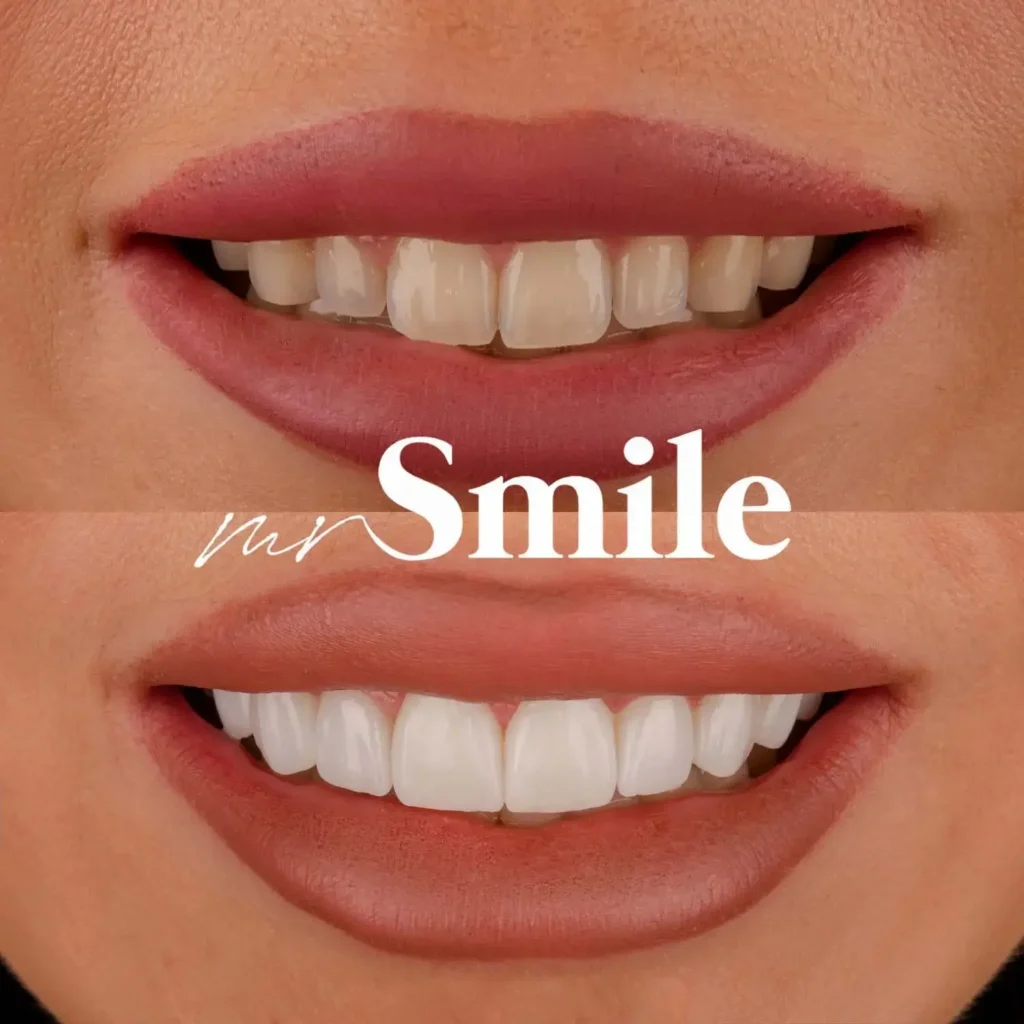
A high-quality photograph can show the visual change in the shape of the teeth, their apparent length and width, the spacing between teeth or the relationship between the smile and the lips. When photographs are taken under similar conditions, contours and proportions can be compared more effectively. That is why result galleries are valuable: they help a person to describe more precisely what concerns them and the kind of smile they hope for.
However, a photograph cannot replace an examination. It does not reliably show the condition of the tooth root, any interproximal caries, periodontal health, occlusal contact during chewing or the thickness of the ceramic. Even when you see a harmonious result, you cannot conclude from the image alone how the patient feels, whether the bite has been previously treated, or what maintenance plan they have.
The aesthetic difference is not the same as the clinical outcome
Two smiles can appear equally attractive in a photograph yet have been achieved by completely different therapeutic routes. In one case small shape corrections are sufficient, while in the other a more complex plan is required. The correct question therefore is not just “Do I like the final image?”, but “What was necessary to achieve that result?”
What is not visible in the before-and-after photograph?
The quality of the marginal adaptation of the restoration, the possibility of maintaining hygiene between the teeth, bite stability or any sensitivity after the procedure are not always visible. A dentist is required to assess these elements. Therefore, it is useful for photographs to be accompanied by a description of the indication, the type of treatment and any additional procedures — without disclosing the patient’s personal medical data.
What are No Prep veneers and why is the initial condition so important?
No Prep veneers are thin aesthetic restorations that, in appropriate cases, can be placed with minimal or no prior enamel preparation. Their purpose may be to correct certain aesthetic features: shape, minor spacing, visible irregularities or the relationship of individual teeth within the smile. The term "No Prep", however, is not a guarantee that every tooth is suitable for such a procedure, nor does it mean every patient will receive the same plan.
If the teeth are already prominent, very wide or poorly positioned, adding material without preparation can create excessive bulk. If there is untreated caries, active gum disease or a bite/occlusal problem, the health or functional issue needs to be addressed first. Aesthetic solutions make sense when they fit within the state of oral health, not when they mask it.
Why 'No Prep' does not mean 'no assessment'?
Preserving natural tooth tissue is a worthy goal, but it is determined by an examination, not a slogan. The dentist assesses the space for the restoration, tooth shape, contacts, gums and expected function. In some cases the choice may be a No Prep technique; in others minimal preparation, orthodontic therapy, bonding or another option is recommended. The correct plan is never based solely on achieving a photograph that resembles the desired result.
Seven details to pay attention to when viewing a Before/After gallery
When you open the gallery, do not linger on the overall impression alone. The following seven details enable a more reasonable comparison of the photographs, particularly when you are considering veneers for the front teeth.
1. Are the angle, lighting and facial expression comparable?
If the 'before' photo is darker, taken closer or from a different angle, the difference may appear more dramatic than in reality. In the 'after' photo the smile is often wider and the lips positioned differently. Professional dental photography aims to standardise the framing, distance, head position and lighting. When conditions are not the same, the result is not necessarily poor — it is simply harder to compare objectively.
2. Is the change in colour natural for the face?
A stark white colour may look impressive on a phone, but pleasing aesthetics do not depend on a single universal shade. When choosing a colour, complexion, the natural translucency of the teeth, the existing colour of neighbouring teeth and the lighting are important. Teeth are not flat white surfaces; their natural appearance often arises from subtle variations in shade, brightness and translucency. For that reason, a valuable Before/After example shows the smile in the context of the whole face, not solely in an extremely close-up frame.
3. What is the length-to-width relationship of the front teeth?
Check whether the central incisors appear proportionate, how their length relates to the neighbouring teeth and whether the change in shape is overly pronounced. A photograph can be attractive even when the teeth look symmetrical, but perfect symmetry is not necessarily the goal. A natural smile often retains individual characteristics. Good planning entails that proportions suit the person’s face and expressions, rather than applying the same template to everyone.
4. How do the gaps and contacts between the teeth appear?
If small gaps existed before treatment, pay attention to how they were closed. Excessively wide teeth can close the space but appear unnatural. It is also important that the contacts and contours between teeth are suitable for hygiene. This cannot be fully assessed from a photograph, but you can ask the dentist how the relationship between tooth width and the available space was planned.
5. Do the teeth appear overly bulky?
With the No Prep approach this detail is particularly important. Since the restoration is added to the existing tooth, it is necessary to assess whether there is enough space for a harmonious contour. If veneers make the teeth more protrusive or visually thickened, that type of restoration may not be ideal for every tooth position. Ask how the thickness was assessed in the specific case and whether an alternative method would yield a more natural result.
6. What is the relationship between the teeth and the gums?
A nice photograph is not just a story about white teeth. Pay attention to the gum line, the visibility of the gingiva in the smile and whether the front teeth appear harmonious in relation to the soft tissues. The condition of the gums is a clinical matter and cannot be confirmed by a photograph alone. If the gums are inflamed or bleed, diagnostic assessment and appropriate treatment are required before an aesthetic restoration.
7. Has the result been documented immediately or after a certain period?
A photograph taken immediately after treatment shows the aesthetic effect at that moment, but does not provide enough information about the long-term behaviour of the restoration. It can sometimes be useful to see a follow-up result with the stated interval and circumstances, if such material is available and the patient has given consent. Do not assume that an image was taken months or years later unless this is explicitly stated.
How do you distinguish a good case study from a marketing photograph?
A reliable depiction of a transformation does not have to be the most attractive. It should explain what the aesthetic problem was, which options were considered and which method was chosen. Even a brief description can mean a lot: for example, "shape correction and closure of a small gap" is more precise than the general claim "a completely new smile".
A good case study, with the patient's consent, can include photographs taken under similar conditions, a description of the initial situation, the name of the procedure and a note that the plan is tailored to each individual. It is not necessary to disclose the patient's identity or details of their records. Professional presentation of results should preserve the patient's dignity and the realistic expectations of prospective candidates.
Are filters and retouching acceptable?
Exposure adjustments used to ensure consistent presentation are technically different from altering the shape of teeth, erasing defects or digitally whitening the final photograph. When images are manipulated so that they appear to show a result that has not actually been achieved, comparisons become misleading. If something looks unusual to you, it is entirely reasonable to ask the practice how the photographs were produced and exactly what they represent.
Three common initial problems: which results make sense to compare?
The most useful example is not necessarily the one showing the largest change, but the one that corresponds to your starting condition. If you are seeking correction of a single flaw, a photograph of a complex reconstruction does not tell you much about what you might reasonably expect.
Small gaps between the front teeth
With smaller gaps, photographs can show how changing the width of the teeth affects the overall smile line. But not every gap is best treated with veneers. If the cause is tooth position or the relationship of the jaws, orthodontic treatment may be a more appropriate solution. At the consultation, ask whether aesthetic space closure is suitable for your anatomy and bite.
Smaller or irregularly shaped teeth
When individual teeth are smaller or have uneven contours, restoration can sometimes contribute to more harmonious proportions. Consider whether the result harmonises with the appearance of neighbouring teeth and the natural smile line. A good treatment plan does not need to involve all visible teeth if the objective can be achieved with a less extensive procedure.
Wear, damage and discolouration
Wear and damage may have causes that require specific management: from habits and tooth contacts to problems related to the bite. Discolouration can have various origins. Before selecting veneers, it is important to assess whether whitening, a composite restoration, tooth protection or another treatment would be more appropriate. The “after” result may be aesthetically pleasing, but the treatment decision must address the underlying cause of the problem whenever possible.
How does Mr Smile plan the result before the 'after' photograph is taken?
The advantage of an individualised approach is not only in the choice of shade but in connecting several important elements: the patient's wishes, the examination, the relationship between teeth and face, function and the choice of materials. On the page No Prep veneers by Nemanja Mihaljčić Mr Smile presents a methodology for planning aesthetic proportions and linking it with the Preview procedure. It is a useful basis for discussing possibilities, but the final indication should always be determined by the dentist.
Mr Smile Preview: a discussion about the shape before the decision
Mr Smile Preview serves as a way to discuss the proposal for a future smile and to clarify expectations. The patient can explain more precisely whether they want a subtler change or a more pronounced correction, what they like about the reference photographs and which features of their own smile they wish to retain. Preview is a planning and communication tool; a digital representation or model is not a guarantee that the final result will be entirely identical to the simulation.
Laboratory work and details not visible in the photograph
Mr Smile emphasises collaboration with its own laboratory and the individual fabrication of prosthetic restorations. In practice, aligning the plan with the technical possibilities of production helps the discussion about the shape, shade and character of future restorations. However, quality cannot be demonstrated by the mere existence of a laboratory: precise indication, quality of workmanship, correct trial fitting, follow-up checks and maintenance are important.
Why is this approach more valuable than choosing the 'prettiest picture'?
Because it begins by asking what suits your smile specifically, rather than copying someone else's teeth. Photographs can serve as inspiration, while examination and planning allow the limits of the desired change to be assessed. This way of working can help make expectations clearer before choosing the definitive treatment. That is precisely why, when comparing clinics, you should also look at the planning process and not only at the gallery of best results.
No-prep veneers or traditional veneers: can the difference be recognised in a photograph?
Not reliably. A post-treatment photograph does not reveal how much enamel was removed, which exact material was used, how the tooth surface was prepared, or whether additional interventions were performed. Two visually similar results can be achieved by different methods.
The American Dental Association and Cleveland Clinic emphasise that many traditional veneers involve removal of some enamel and that such procedures can be irreversible. In No-prep cases the aim is a different approach to preparation where clinically appropriate, but without an examination it is not possible to conclude which procedure is the safest and most suitable. Therefore seek a clear description of the procedure together with the photograph, rather than assuming from appearance alone that the treatment was “no-prep”.
What questions should you ask when you like a particular result?
Bring the photograph to the consultation and use it as an initial reference. You can ask: “Are my teeth similar to the starting condition shown in this photograph?”, “How many teeth would need to be covered?”, “Is there enough space for a No-prep restoration?” and “Is there an option that preserves more natural tooth tissue?”.
Then discuss the expected colour, the possible impact on your bite, maintenance and future check-ups. Ask for a clear explanation of what is included in the plan, which alternative procedures are available and what limitations cannot be demonstrated on Instagram or the website. It is also useful to ask how the process of selecting the final shape through Preview and a trial fitting will work, if such a step is planned for your case.
Six questions you can bring to the consultation
- What, in my case, is an aesthetic issue and what requires medical treatment?
- Am I a candidate for No Prep veneers, or would the addition of material create excessive bulk?
- Is there an alternative solution: bonding, whitening, orthodontics or another procedure?
- How do we choose the shape and colour so the result looks natural?
- Will I see a smile preview before the final decision, and what does that preview realistically show?
- How are restorations maintained and when should I come for check-ups?
Why is a "Hollywood" result not always the best outcome?
On social media, very white, perfectly uniform teeth often attract the most attention. Such an appearance may suit someone’s aesthetic preferences, but it is not a universal measure of quality. For some, a subtle, unobtrusive adjustment that preserves the character of the original smile is more appropriate. For another person, a change in proportions or shade may be important. Good planning respects both — to the extent that it is safe and achievable.
It is particularly important to preserve functionality. A smile that looks good in a photograph must also fit with speech patterns, jaw relationships and chewing. Therefore an aesthetic treatment should not be reduced to choosing a catalogue shade or a shape based on a celebrity photograph. The aim is a personalised decision, with an understanding of any potential compromises.
What does a long-term result mean, and why is that not the same matter as the photograph taken on the first day?
Veneers require daily oral hygiene, regular check-ups and attention to habits that may place strain on the restorations. Longevity depends on several factors: the material, appropriate indications, tooth relationships, habits, maintenance and individual conditions. No photograph taken immediately after treatment can be proof of the long-term behaviour of veneers.
If you see an "after several years" display, ask whether it is the same case, when the photograph was taken and whether there have been any interventions in the meantime. Those are legitimate questions, but not every public portfolio must contain multi-year follow-up photographs. It is far more important that the practice explains how you will maintain the restorations and which signs require monitoring.
How to maintain a smile after the placement of veneers?
The basis is regular brushing of the teeth, interdental cleaning and individually recommended dental check-ups. If you have a habit of clenching or grinding your teeth, be sure to discuss it with your dentist. Do not use your front teeth to open packaging or to bite very hard objects. Specific recommendations vary according to the material and condition of the teeth, so they should be obtained from the team that carried out the treatment.
Is a Before/After gallery sufficient to choose a clinic?
No. A gallery can be a good source of inspiration and can show the aesthetic style a clinic favours. However, when choosing, also pay attention to professional consultation, explanations of alternative treatments, a transparent treatment plan, the process for selecting colour and shape, answers to questions about potential risks, and clear maintenance instructions.
Mr Smile may be of particular interest to people who wish to discuss a potential transformation through the methodology. No Prep veneers by Nemanja Mihaljčić, Smile Preview and work with the laboratory. These are concrete elements you can verify during a consultation. They are a more useful basis for considering Mr Smile than the unverifiable claim that any practice gives everyone “the best smile”.
Patient privacy: how to publish results responsibly?
Photographs from a dental practice can disclose information about a person’s health, and portraits can enable identification. Therefore, public publication requires an appropriate legal basis and carefully documented consent when it is required. Consent to a medical procedure is not automatically consent for photographs to be published in a marketing gallery.
This is important both for patients viewing the results and for practices publishing them. A curated gallery does not need to include the patient’s name, age or personal history to be useful. A clinically relevant description, authentic photographs and a note that outcomes are individual often provide more than enough context.
Your new smile
begins here.
Every transformation begins with a conversation. Book a consultation and discover the possibilities for your smile.
BOOK AN APPOINTMENTFrequently asked questions about No Prep veneers before and after
Do the photographs guarantee that I will receive the same smile?
No. Tooth shape, positioning, gum condition, bite and patient preferences vary. A photograph can serve as a visual reference, but it cannot guarantee an identical outcome.
Can I recognise from a photograph alone that the veneers did not require preparation?
Not reliably. Details of the technique used and the clinical procedure are required. The appearance of the finished restoration by itself does not demonstrate the method of preparation.
What if the 'after' photograph appears unnaturally white?
Differences in lighting, white balance and image processing can affect perception. At the consultation, request a discussion about realistic shades, the characteristics of the ceramic and how the colour will appear in relation to your face.
Is it better to look at a close-up of the teeth or a photograph of the whole smile?
Both types of photographs are useful. A close-up shows the contours and surface of the teeth, while a photograph of the smile helps you assess the relationship with the lips and face. It is best to have both views when available.
How important is it that the images are taken under the same conditions?
It is very important for objective comparison. Different lighting, distance and angle can change the perception of the colour, shape and size of the teeth. Standardisation of photographs facilitates comparison.
Can a small gap between teeth be closed with No Prep veneers?
Sometimes it can, but not every gap closure is best treated with a restoration. The dentist should assess the cause of the gap, the tooth proportions and the bite, as well as alternative solutions.
Does the Mr Smile Preview show the guaranteed final result?
No. The Preview is intended for communication and planning of the desired aesthetics. The final plan and feasibility are determined after clinical assessment and during the appropriate stages of treatment.
Can all patients receive veneers without preparation?
No. Limitations may exist due to tooth position, lack of space, oral health or functional circumstances. Some patients benefit more from an alternative method or a combined treatment plan.
How many photographs should be reviewed before making a decision?
There is no prescribed number. It is more important to look at a few relevant examples and understand their context than to review hundreds of photographs without a description of the procedure. A consultation is the next important step.
How can I know whether the result will be stable in the long term?
A photograph from day one cannot prove that. Ask for the maintenance plan, follow-up checks, possible complications and recommendations tailored to your habits and dental condition.
Conclusion: a photograph inspires, but a good plan guides the decision
When you look at No Prep veneers before and after, don't just look for the most dramatic transformation. Look at proportions, the naturalness of colour, the relationship between teeth and gums, the similarity of photographic conditions and, above all, the explanation of how the result was achieved. Photographs help you recognise your own wishes, but cannot replace an examination, planning or an informed discussion about possible alternatives.
If you want to find out what is realistically possible in your case, the Mr Smile approach combines consultation, aesthetic planning and a discussion of the proposed smile through Preview. Book a consultation and bring photographs you like — as a starting point for an individual consultation, not as a promise of an identical replica.
The information in the article is educational and does not constitute personal dental advice. Consultations with a specialist are required to assess the appropriate treatment.